Stop prototyping, start building: How AI is shaping product & design in 2026
.png)
At Lindus, we believe AI will empower our tech organization to build better products. LLMs are unlocking potential across product management, design, and engineering, in ways that would have seemed far-fetched even two years ago. But the way we work is changing fast, and we think it's worth sharing what that looks like in practice.
The traditional product development model is being turned on its head
Even in the most agile of environments, building software products has long followed a fairly sequential path:
- Identify a problem area
- Build an understanding of the user need and try to identify the root cause
- Explore the solution space and build prototypes using design tools
- Test with users, then narrow down to a specific feature that can be feasibly delivered
- Work with engineering to ship something specific that should solve the user's needs
- Measure and build an understanding of whether the problem has been solved.
Once you add a dusting of "planning inertia," you end up with a process that feels long-winded and predictable; one that, even when executed to a high standard, offers no guarantee of success.
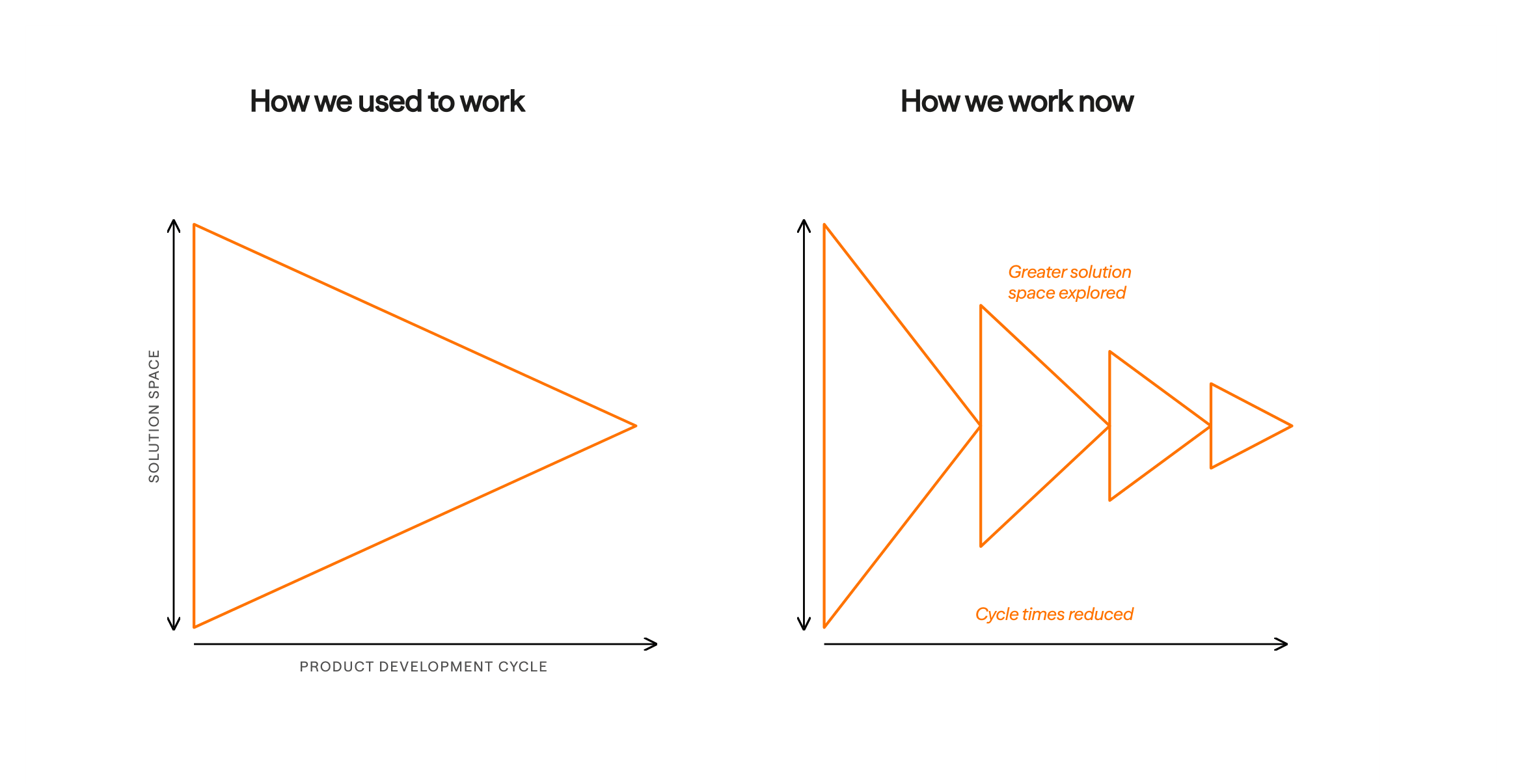
The key point is that this process also generally moves from broad to narrow, and at each stage, fidelity increases while optionality decreases. This is the fundamental tension with continuous product discovery: the moment you increase fidelity, you start closing doors.
The prototype stage has always been the sharpest expression of this problem. However polished, working prototypes were ultimately click-through mockups, useful for testing flows and concepts, but a long way from the real thing. What you could feasibly test was constrained by what you could prototype in a design tool, meaning discovery was bounded by the limits of simulation. Design prototypes are also costly to produce, often requiring multiple weeks and rounds of group review before settling on a solution worth putting in front of users.
That constraint is dissolving. With tools like Claude Code, prototypes are becoming genuinely functional product features, built on branches off the same repo you're shipping to. You could have five branches open at once, each containing a working prototype being tested with real users inside an exact replica of your live product. The solution space you can explore has expanded dramatically, and the gap between "testing an idea" and "validating a solution" is narrowing fast.
Vision matters more, not less
On the flip side, there will be much more emphasis on deciding what not to ship. More than ever, tech teams risk falling into the age-old trap of becoming feature factories, ticking off customer requests and delivering precisely what users ask for, without moving the needle on their product vision or differentiation. To this end, weak product vision and strategy will be identified faster, and the likelihood of building overly complex, convoluted products increases. Without solid foundations unifying teams on where they are trying to get to, there is also an increased risk of squads and internal teams pulling in different directions.
What this means for the product team at Lindus
The implications extend well beyond product and design. Getting here has required a steep learning curve: understanding MCPs, building an AI-assisted development ecosystem, and enabling genuine cross-functional contribution to the codebase. At Lindus, our design team has developed internal tooling to make Git accessible to people who've never written a line of code, because we believe the ability to contribute to product development shouldn't be gated by engineering background.
And what about engineers? Some assume they're the function most at risk as AI takes on more of the build work. We've found the opposite. With routine coding tasks increasingly handled by AI, engineers have more time for the work that requires their expertise: contributing technical judgment earlier in the solution design process, ensuring what we're shipping solves real user problems, optimizing the underlying infrastructure of the product, and making the right architectural decisions that compound over time. Ultimately, they have more space for what great engineering has always been about, building things that are both technically sound and genuinely useful.
The best product teams have always known that discovery and delivery are inseparable. AI is finally making that true in practice. The old tension between fidelity and discovery space is being upended; you can now explore broadly and build the real thing at the same time. However, that makes strong product vision and cross-functional collaboration more important than ever. The teams that get those fundamentals right won't just move faster. They'll test more ideas, make better-informed decisions, and ship features more likely to improve product outcomes,