
Blog
Diagnostic

Maintaining Complete Long-Term Follow-Up Data in Large-Scale Oncology Screening Trials
Hannah Gledhill
VP of Programme Operations
Hannah joined Lindus from Accurx, a healthcare communications platform, where she led market strategy, growth, and go-to-market operations. Before that, she was a Lead Consultant at Newton Europe, specializing in operational improvement across healthcare and the public sector. She holds an MEng in Aerospace Engineering from the University of Cambridge.
Gaby Blume
VP of People and Operations
Gaby spent four years as Commercial Director at Papier, a direct-to-consumer startup, where she was part of the leadership team that scaled the business fivefold in people and revenue through Series A to C. She holds an MChem in Chemistry from the University of Oxford.
Shawn Malloy
VP of Marketing
Shawn is a biomedical engineer by training, with a BSc and MSc from Cornell University. He spent five years in drug and device development at AbbVie, Biogen, and Amgen, working on combination products, intrathecal devices, and cardiovascular assets from concept through FDA approval, with five granted patents as primary inventor. He then led marketing at Curebase, a decentralized clinical trial platform, where he built the marketing function and led commercial growth.. He also holds an MBA from Boston University and a PMP certification.
Dr. Khawar Hussain
Dermatology
Khawar is a consultant dermatologist at Chelsea and Westminster Hospital NHS Foundation Trust, treating both paediatric and adult patients across atopic dermatitis, psoriasis, hidradenitis suppurativa, and acne. He is an Honorary Clinical Senior Lecturer at Imperial College London and a principal investigator on multiple active clinical research trials. He has published over 60 peer-reviewed papers, including research on checkpoint inhibitor-induced psoriasis and dupilumab outcomes in paediatric atopic dermatitis. He sits on national clinical guideline committees.
Malcolm Fogarty
VP of Strategic Partnerships
Malcolm has over 25 years of international experience in life sciences and health technology. At GSK and Haleon, he served as Chief Growth and Innovation Officer, leading commercial innovation and strategic partnerships.
Chris Reist, MD
Psychiatry
Chris is a board-certified psychiatrist and Professor Emeritus at the University of California, Irvine. He has led over 40 clinical trials as principal investigator across PTSD, major depressive disorder, and schizophrenia, including novel approaches such as virtual reality exposure therapy and stellate ganglion blockade for PTSD. He has published over 80 papers on pharmacogenetics and psychiatric drug development, and previously served as Associate Chief of Staff for Research at the Long Beach VA Healthcare System, overseeing research infrastructure serving 40,000+ enrolled veterans.
Richard McCormick
VP of Clinical Solutions
Rich is a clinical research executive with over two decades in oncology trial management. He built his foundation during an 11-year tenure at PPD, progressing from Research Associate to Project Manager across global oncology programmes. He went on to lead immuno-oncology project management at IQVIA Biotech, then held senior roles at Novella Clinical (now IQVIA), KCR, Vial, and ICON Biotech. His career spans Phase I through Phase IV oncology studies, with particular depth in immuno-oncology clinical strategy and global trial oversight.
Cristy Patterson
SVP of Commercial
Cristy has over a decade of experience scaling technology-enabled clinical research and real-world evidence businesses. She most recently served as Vice President of Life Sciences at Topography Health, expanding the company's pharma and biotech relationships and channel partnerships with major CROs. She previously led large-scale real-world evidence programs at Evidation Health, and began her career in healthcare finance and clinical research. She holds an MBA from UC Berkeley's Haas School of Business and a BA in Biology from Amherst College.
Dr. David Cohan
Oncology diagnostics
David is an oncology clinical development executive serving as VP of Global Clinical Development at Fortvita Biologics. He previously held roles at Pyxis Oncology and Replimune, where he contributed to the development of RP1 (vusolimogene oderparepvec), an oncolytic immunotherapy now under FDA priority review. He also held roles at Secura Bio and Alkermes. Before industry, he was an Attending Surgeon and Assistant Professor in Head & Neck Surgery at Roswell Park Comprehensive Cancer Center. He holds an MD from Stanford.
Veronica Vu
VP of Data
Veronica Vu is a clinical data executive driving next-generation data strategy and delivery across clinical trials. She began in clinical data management for interventional medical device studies and progressed to leading data delivery functions at Verily, Faro, and Lindus. At Lindus, she oversees deployment, data management, and biostatistics for the full trial portfolio, driving quality and automation at the intersection of clinical operations and product. Her work spans decentralized trial platforms, data-driven trial design, and scalable, standards-based delivery, with a focus on improving data quality, automation, and operational efficiency to modernize how clinical trials are designed and executed.
Paul Billings, MD, PhD
Diagnostics
Paul was Chief Medical Officer at Natera, a global leader in cell-free DNA testing, where he oversaw diagnostic programmes across reproductive health and oncology. He also led Biological Dynamics as CEO, a liquid biopsy diagnostics company focused on early-stage cancer detection. He has authored over 250 publications on genomic medicine and held academic appointments at Harvard, UCSF, Stanford, and UC Berkeley. He sat on the FDA's Science Board and the HHS Secretary's Advisory Committee on Genetics, Health, and Society. He holds an MD and PhD in Immunology from Harvard.
Chris Butler
Primary Care and Infectious Diseases
Chris is Professor of Primary Care at the University of Oxford and Clinical Director of the Primary Care Clinical Trials Unit. He has led or co-led over 30 randomised clinical trials recruiting 40,000+ participants, including the PRINCIPLE and PANORAMIC adaptive platform trials for COVID-19 community treatment, evaluating nine medicines. He has published over 500 papers across respiratory infections and COPD, with results in The Lancet, The BMJ, and the New England Journal of Medicine. His H-index exceeds 80.
Dr. Luke Twelves
VP of Medical
Luke is a physician with nearly three decades of clinical and leadership experience. He was Lindus employee number three. He previously served as CEO of Omnes Healthcare, delivering dermatology, ENT, diagnostic, and general practice services to the NHS, and directed clinical governance at UnitedHealth Group (Optum). He continues to practise as a GP alongside his role at Lindus, bringing frontline clinical perspective to the medical oversight of every trial. He trained at the Universities of Oxford and Cambridge, and holds an MBA from Durham University.
Heather Davis
VP of Clinical Operations
Heather has over 30 years of experience in clinical operations, spanning clinical site, biotech, and CRO environments. She co-founded Highline Sciences, an oncology-focused CRO, and served as its COO, scaling the company from seven employees to over 100 before its acquisition by Tempus AI. She remained as COO of Tempus Compass, integrating technology with clinical operations and supporting the company through its IPO. Her earlier career includes senior roles at Precision For Medicine, SynteractHCR, and Novella Clinical (now IQVIA), across oncology, immunology, and neurology.
Peter G. Polos, MD, PhD
Respiratory
Peter is a practicing pulmonologist and Associate Professor at Hackensack Meridian JFK University Medical Center. As Principal of Global Clinical Consulting, he has led clinical development and medical monitoring across 50+ Phase I–IV studies in asthma, COPD, and sleep medicine. He spent eight years as Global Director of Scientific Affairs at Merck, where he contributed to the montelukast (Singulair) clinical programme. He is a Fellow of both the American College of Chest Physicians and the American Academy of Sleep Medicine.
Dr. Alessandro Falcone
Alessandro is a medical doctor and life sciences executive currently serving as Regional Head of JLABS Singapore for Johnson & Johnson. At AstraZeneca, he served as Executive Director of Breast Cancer Oncology R&D Clinical Development Strategy, leading clinical programmes for three marketed oncology therapies: Enhertu, Lynparza, and Imfinzi. He previously held R&D leadership roles at GSK and strategy roles at Novartis. He holds an MBBS from UCL and an MSc in Experimental and Translational Therapeutics from the University of Oxford.
Gemma Harrison
Chief Product & Technology Officer
Gemma leads R&D of CitrusTM, Lindus’ AI-native operating system. She is a technology executive who has spent her career building and scaling engineering teams. Before Lindus she spent three years as a Principal Software Engineering Manager at Microsoft, leading teams of up to 30 engineers on Telecoms products in Azure. Prior to that she spent 23 years at Metaswitch Networks, advancing from Software Engineer to Senior Software Engineering Manager. She holds a BA in Mathematics and a Diploma in Computer Science from the University of Cambridge, and is an active advocate for women in technology.
Dr. Carel le Roux
Cardiometabolic
Carel is the Director of the Metabolic Medicine Group at University College Dublin. He served as principal investigator on the Boehringer Ingelheim Phase 2 survodutide trial — a glucagon/GLP-1 receptor dual agonist for obesity — published in The Lancet Diabetes & Endocrinology. He is a co-investigator on the SYNCHRONIZE Phase 3 programme and the TRIUMPH retatrutide trials in obesity and obstructive sleep apnea. He has over 350 publications with 22,000+ citations across obesity, type 2 diabetes, and gut hormone research.
Dr. Tim Garnett
Tim spent 23 years at Eli Lilly, serving as Chief Medical Officer and Senior Vice President from 2008 to 2021. He oversaw regulatory affairs, patient safety, and clinical development across the US, Europe, China, and Japan, and led the global development of duloxetine across depression, pain, and incontinence indications. He also managed the raloxifene (EVISTA) programme in women's health. He currently chairs the board of Ophirex and serves as a board member for MapLight Therapeutics and Cardiol Therapeutics.
Michael Young
Co-CEO
Michael was previously a Special Adviser to the UK Prime Minister, where he advised on a range of issues including life sciences. Before serving in government, he worked at McKinsey & Company and L.E.K. Consulting, predominantly on commercialization and M&A in the healthcare space. His time in government during the pandemic showed him how much trial delivery depended on fragmented, outdated infrastructure, and convinced him the industry needed a fundamentally different operating model; without this none of the groundbreaking advances in understanding human biology will ever benefit patients. He founded Lindus to fix these bottlenecks.
Dr. Joanne Fletcher
Joanne is an R&D leader with 20+ years in respiratory clinical operations. At GSK, she was instrumental in delivering the landmark Salford Lung Studies, among the largest pragmatic real-world effectiveness trials ever conducted in respiratory medicine.
Dr. Michelle Griffin
OB/GYN
Michelle is the founder of MFG Health Consultancy, where she partners with women's health founders to take innovations from concept to commercial success, helping secure over $85 million in investment. She led the NHS implementation of Stella, a clinically validated app for menopause treatment, and is the author of Fibroids (Penguin Random House). Her clinical career spans obstetrics and gynaecology, Cancer Research UK, and a WHO fellowship developing Zika virus management protocols for pregnant women.
Robert Langer
Robert S. Langer, ScD, co-founded Moderna and over 40 other biopharma companies. He holds 1,400+ patents licensed to 400+ pharmaceutical, biotech, and medical device companies, and is one of three living individuals to have received both the US National Medal of Science and the National Medal of Technology and Innovation. He is an Institute Professor at MIT — the institution's highest faculty honour — and a member of the Koch Institute for Integrative Cancer Research. He is the most cited engineer in history, with over 1,600 published papers.
Meri Beckwith
Co-CEO
Lindus
Moderator
Meri is a former life sciences and healthtech venture capital investor, with an MSc in Biology from the University of Oxford. Serving on the boards of health and biotech companies, he saw CROs repeatedly fail to deliver clinical trials on time and on budget. After participating in a COVID-19 vaccine trial, he saw how fragmented integrated technology, poor patient experience and operational problems at sites cascaded up to the cost and timeline overruns he experienced as an investor. He founded Lindus to fix these problems and provide a more accountable, predictable model for research.
Dr. John Matthews
Chief Medical Officer
ReCode Therapeutics, Guy's and St Thomas' NHS Foundation Trust, Imperial College
John is a pulmonologist and clinical drug developer with over 21 years of experience across all phases of development, including large and small molecules and inhaled drug delivery. Previously held leadership roles at GSK, Roche/Genentech, and 23andMe. Ph.D. in respiratory clinical pharmacology from Imperial College London.
Monique Ortega
Senior Trial Manager
Lindus
Rebecca Brownlee
Associate Director Clinical Operations
Lindus
Lauren Bullard
Senior Project Lead
Lindus
Dr. Shannon MacLaughlan David
Dr. Beata Godlewska
Principal Investigator
University of Oxford
Panelist
Beata is a Senior Clinical Researcher and Honorary Consultant Psychiatrist at the University of Oxford's Department of Psychiatry, where she has worked since 2007. She received her medical degree and PhD from the University of Gdańsk in Poland before moving to Oxford. Her research focuses on the psychopharmacology of mood disorders, including major depressive disorder and bipolar disorder, with a particular focus on early detection and treatment-resistant forms of these conditions, and on the biological mechanisms of antidepressant drug action. Alongside this, her work has extended into understanding the underlying biology of ME/CFS with a view to future treatment development, which informs her approach as Principal Investigator on ReMEdi. She has maintained clinical practice throughout her academic career, working as an Honorary Consultant Psychiatrist within the Mood Disorders Treatment Clinic since 2010, and brings that combined research and clinical perspective to leading ReMEdi's clinical conduct in a fully remote setting.
Dr. Simon Bock
Clinical and Market Access, Portfolio & Innovation Manager
Tiefenbacher Group
Panelist
Simon is Clinical and Market Access, Portfolio & Innovation Manager at Tiefenbacher Group, where his work spans portfolio planning, study conception, regulatory correspondence, market access, and digital health innovation. His background combines pharmaceutical industry experience with nearly eight years of community pharmacy practice at Priv. Adler Apotheke in Hamburg, an unusual combination that informs how he evaluates whether a development programme will translate into something patients can actually access. At Tiefenbacher, he represents the sponsor on the ReMEdi programme, a fully virtual Phase 2 trial in ME/CFS, and contributes to the broader portfolio strategy for repurposing-led development in neglected and underserved indications, where commercial attractiveness and patient access have to be designed in from the outset rather than bolted on at launch.
Dr. Alexander Miras
Zaid Al-Jubouri
Senior Software Engineer
Experienced in building applications from end-to-end. Always interested in the latest in the software engineering landscape.
Wes Hassan
Head of Growth
Started his career as a Medical Device engineer. Since then, he has helped scale companies from 0->1, working primarily in growth and business development functions.
Tessa Griffiths
Trial Manager
Experienced Clinical Research professional with over 7 years experience in the management & delivery of complex research projects. Previously worked on large scale adaptive and novel trials in the Oncology disease area with experience across both academia and industry.
Taylor Sardoff
Trial Coordinator
Previous experience as clinical research coordinator for top ranked institutions such as NYU Grossman School of Medicine. Worked in both investigator-initiated and global clinical trials, largely in the therapeutic fields of Psychiatry and Cardiology.
Tanja Fischer
Head of Finance
Tanja is a CIMA-qualified Finance professional with a generalist background who has spent 4+ years working in and building out Finance functions in start ups and scale ups ranging from Seed to Series C. Passionate about process automation and improvement
Shreya Kalyanasundaram
Solutions Engineer
Biomedical engineer with a background in software development, clinical research and building early-stage companies. Passionate about bridging the gap between patients and high-quality healthcare treatments.
Shenna Cadiente
Trial Coordinator
Experienced clinical research nurse working across adult and paediatric trials managing and delivering Rare Disease research studies. Passionate in maximising the efficiency of research through public involvement and patient-centred approach.
Samantha Brooks
Trial Manager
Clinical research scientist with 10+ years of experience leading and managing rigorous research projects. Expert in dietary and exercise interventions to optimise metabolic health. Passionate about improving human health through clinical trial research.
Rianna Mortimer
Trial Manager
Clinical trials researcher who has 5 years experience working across both academia and MedTech startups, with a background in medical statistics. Passionate about high research standards and a patient-centred approach
Rebecca de Rome
Head of Operations
Previously a consultant to the pharmaceutical sector at Simon-Kucher & Partners, advising on market access and pricing.
Oskar Wroz
Software Engineer
Software engineer with experience developing AI-enabled drug discovery products. Previously as a React Developer, Oskar also focused on virtual learning products, particularly within the healthcare sector.
Olivia Dantonio
Trial Nurse Coordinator
NMC registered and USA board-certified nurse with critical care experience in the UK and US. Passionate about supporting patients while making evidence-based treatment accessible to wider populations through clinical research.
Nik Haldimann
Co-Founder & CTO
15 years' experience building world-class tech products. Previously at BenevolentAI, Descartes Labs, Placemeter and Google.
Nijat Hasanli
Head of Product
Previous experience building products for early stage companies. Leading the development of our trial delivery platform.
Michele Pedrocchi, PhD
Strategic Advisor to Lindus Health
Certified Board Director, independent Advisory Board Member and Strategic Advisor to Healthcare Companies and Financial Investors (VC, PE). International Manegement Experience in Healthcare, core stations in Corporate Strategy, Commercial Execution and Business Development/Partnering.
Madison Lewis
Digital Marketing Specialist
Performance Marketing Lead, adept in B2B, B2C, and D2C lead generation.
Madeleine De Forest-Brown
Senior Software Engineer
Full stack software engineer with a background in mechanical engineering. Motivated by the advantages available when we bring technology and healthcare closer together.
Lindus Staff
Author
Our in-house team of experts shares insights, updates, and resources to help you stay informed about the latest in clinical research and healthcare innovation.
Lichelle Wolmarans
Senior Product Designer
Product designer with a background in designing accessible digital services and experiences for the public sector and GovTech startups.
Julian Einhorn
Lead CRA
Julian has been involved in clinical trials for over nine years and has played a part in all roles on the site side from study coordination, recruitment, site outreach, regulatory, and data management. Prior to Lindus Health, he worked as a clinical research associate for over 3 years, working with many sites and sponsors across the United States
Jordan Mackie
Senior Software Engineer
MSci Computer Science graduate that has developed cutting edge VR and large-scale simulation products. Determined to streamline clinical trials to accelerate research, bring down costs, and improve healthcare outcomes worldwide.
Jan Multmeier
Biostatistician
Experienced biostatistician, cognitive scientist and health economist. He is interested in how patients and health care providers make decisions under uncertainty.
Gina Falleroni
Talent Partner
5 + years experience partnering, recruiting and onboarding for tech and product teams, mainly in the start up and scale up space. Passionate about building talent strategies and solutions for sustainable business growth
Erin Scholz
Senior Trial Manager
Erin has extensive experience managing clinical trials in several therapeutic areas, including consumer health and infectious disease. She’s passionate about using smart, efficient study design to generate meaningful evidence and improve patient quality of life.
Elaine Cawley
Technical Project Manager
Elaine has worked in various research roles at leading pharmaceutical companies and within e-clinical technology project management. Prior to joining, she was an Advanced Technical Project Manager at AI-enabled drug discovery and development company.
Ece Kavalci
Data Scientist
ML engineer, with MSc from KCL. Leading work on ML-powered tool for protocol design.
Danielle Maas
Senior Trial Manager
Experienced Clinical Research professional with over 7 years experience in the management & delivery of complex research projects. Previously worked on global clinical trials, largely in the Oncology and Infectious Diseases therapeutic areas.
Cecilia Amstalden
Trial Manager
Clinical Trial Manager with several years of experience leading phase I-IV trials, mainly in the Respiratory therapeutic area. Previously responsible for the introduction of the newest ATS/ERS2019 spirometry guidelines in clinical trials
Cassy Keenan
Senior Clinical Nurse Coordinator
NMC registered and experienced general nurse. Plays a vital role in delivering effective clinical research and supporting patients through their treatment in the trial.
Blake Butler
US Trial Coordinator
Experienced researcher with authorship on multiple academic publications in the health and science sphere. He has been a clinical trial coordinator for 2 years, playing a vital role in the success of phase 2-4 trials.
Aysha Baig
Trial Nurse Coordinator
Experienced Clinical Trials Coordinator with over 5 years experience working with CROs & Real World Evidence Consultancies providing a key support for the successful delivery of clinical trials and real world data collection projects for both NHS and pharma clients.
Ariana Duverge
Trial Lead in Clinical Operations
Clinical research leader with a knack for turning complex device and diagnostic logistics into lean, tech-forward flexible trial designs—ranging from emergency-department pilots to multi-site oncology programs. Grounded in women’s reproductive-health research, I recognize the diagnostic gaps women face and now direct a 20-site ovarian-cancer biomarker trial that pairs hybrid methodologies with empathetic stakeholder engagement.
Anthony Brogno
Director of Clinical Operations
Over 15 years of experience in clinical research and patient advocacy. In the first half of his career, he led global clinical trials in various therapeutic areas for different CROs. In the past 7 years, he has worked with organisations of different sizes to develop new and innovative models for conducting clinical trials beyond traditional settings.
Dr. Anita Phung
Medical Monitor
As a medical monitor at Lindus Health, Dr Anita Phung provides clinical oversight for research studies, drawing on her experience as a Portfolio GP with expertise in metabolic health, precision medicine, and digital health.
Amy Moore
Senior Trial Manager
Experienced clinical research specialist with 9 years' experience leading research projects. Previously Director of Research Implementation at the University of Chicago, overseeing a portfolio of clinical research projects in reproductive health.
Amiel Kollek
Senior Software Engineer
5 years’ experience at Meta working on both consumer and business facing products. Passionate about building software that can help improve people's lives.
Adam Kufen
Senior Trial Manager
Experienced Clinical Research professional with nearly 15 years in the management & delivery of complex research projects. Strong foundation in decentralised clinical trials as well as traditional site-based research, specialising in rare paediatric disease.
Zara Liew
Director of Clinical Partnerships
Former consultant to the pharmaceutical sector across several therapeutic areas including immunoncology, digital health and women's health. Supported commercial strategy for biotech and pharma to enter and grow in target markets. Published researcher in infectious disease and drug resistance.
Rob Montgomery
Director of Strategic Solutions
Rob is a Director of Strategic Solutions at Lindus Health, overseeing the design and execution of large-scale clinical trials with a focus on diagnostics and screening studies. He has extensive experience in healthcare product development and clinical trial strategy. With a background in behavioral and clinical science, Rob specializes in translating complex operational challenges into scalable, innovative trial designs.

Meet the panel

Large-scale oncology screening trials require not only enrolling tens of thousands of participants but also keeping them engaged and capturing complete clinical data over years of follow-up. On average, 25-26% of clinical trial participants drop out after expressing consent, and over 90% of studies experience delays linked to retention challenges. In a screening study where cancer events occur in only a small fraction of the population, missing even a handful of cases can compromise endpoint validity.

"Every cancer case in a large screening trial must be fully documented, with complete diagnostic, staging, treatment, and outcome data. Losing even a small number of cases to incomplete follow-up can undermine the statistical power the entire study was designed to achieve. The operational model has to be built around preventing that from the start." - Dr. Paul Billings

The solution requires three interconnected systems working together: 

  1. Personalized (and, where appropriate, automated) participant engagement that surfaces new diagnoses, treatments, and hospitalizations through periodic health status surveys
  2. Nationwide medical record retrieval coverage that can capture complete clinical outcomes data across health systems and facilities
  3. Smart triage layer that directs medical record pulls only where they're needed to control costs without sacrificing data completeness 

All three systems are enabled by the same decentralized or hybrid trial design described in Part 1: neither the participant nor their data is tethered to a physical site, which means follow-up continues regardless of where a participant lives, moves, or receives care.

Reducing Participant Burden to Sustain Multi-Year Engagement

The majority of participants in a screening trial remain asymptomatic and healthy throughout the study. They may have no symptoms driving them back to a clinic, no personal health motivation to stay engaged, and minimal touchpoints with the study team. Over multiple years, people can naturally disengage, change their contact information, or simply forget they enrolled.

Sustaining engagement with this population starts with reducing the burden of participation. The same decentralized infrastructure described in Part 1 (home phlebotomy, local lab networks, flexible self-scheduling) removes friction that would otherwise drive attrition during follow-up: no travel to distant sites, no repeated coordination with research staff, no passwords or app downloads to remember. Because the study design isn't completely tied to a physical site, participants who relocate can continue remotely wherever they are. But low-burden logistics alone aren't enough to keep asymptomatic volunteers engaged over multiple years. The study needs an active engagement layer built on top of that foundation.

That engagement layer starts with brief, periodic health status surveys (e.g., quarterly or semi-annual) that participants complete on their own devices. These surveys serve a dual purpose: they maintain a regular touchpoint between the participant and the study, and they surface health status changes (new diagnoses, treatments, hospitalizations) that trigger targeted downstream data collection. The survey experience has to minimize friction - deployment as a simple web link with no app downloads, no login credentials, and no portal to navigate is an effective way to achieve this. Personalized, automated reminders via email and SMS, configurable at the individual participant level so timing fits each person's routine, keep response rates high without requiring manual outreach for the vast majority of participants. Citrus™, Lindus' eClinical platform, is purpose-built for sustained, low-friction participant engagement across large populations.

The content of those communications matters as much as the timing. Pre-appointment reminders with clear instructions, thank you messages after completing activities, and progress updates highlighting each participant's contribution to cancer research all help sustain the sense of purpose that keeps asymptomatic volunteers engaged over years, not just months. 

Behind this participant-facing layer sits a structured escalation system designed to catch disengagement early. Dedicated virtual patient coordinators provide proactive outreach to participants who show signs of disengagement, with automatic escalation workflows that flag at-risk individuals before they're lost to follow-up. When a participant misses an ePRO or scheduled activity, the system initiates automated reminders within specified days of the due date. If the participant still hasn't responded, the platform flags the overdue activity to the trial coordinator, who begins direct outreach via phone and email. If multiple contact attempts over several days don't re-engage the participant, the case is escalated to the broader study team and sponsor for review. Every contact attempt is documented, creating a complete audit trail that demonstrates the study made every reasonable effort to retain each participant. Figure 1 illustrates this escalation framework.

Nationwide Medical Record Retrieval Across Distributed Care Settings

In a screening trial at this scale, cancer diagnoses, treatments, and outcomes will be documented at thousands of different healthcare facilities. Participants receive care from their own providers, not from the study site. The record retrieval infrastructure has to reach all of them.

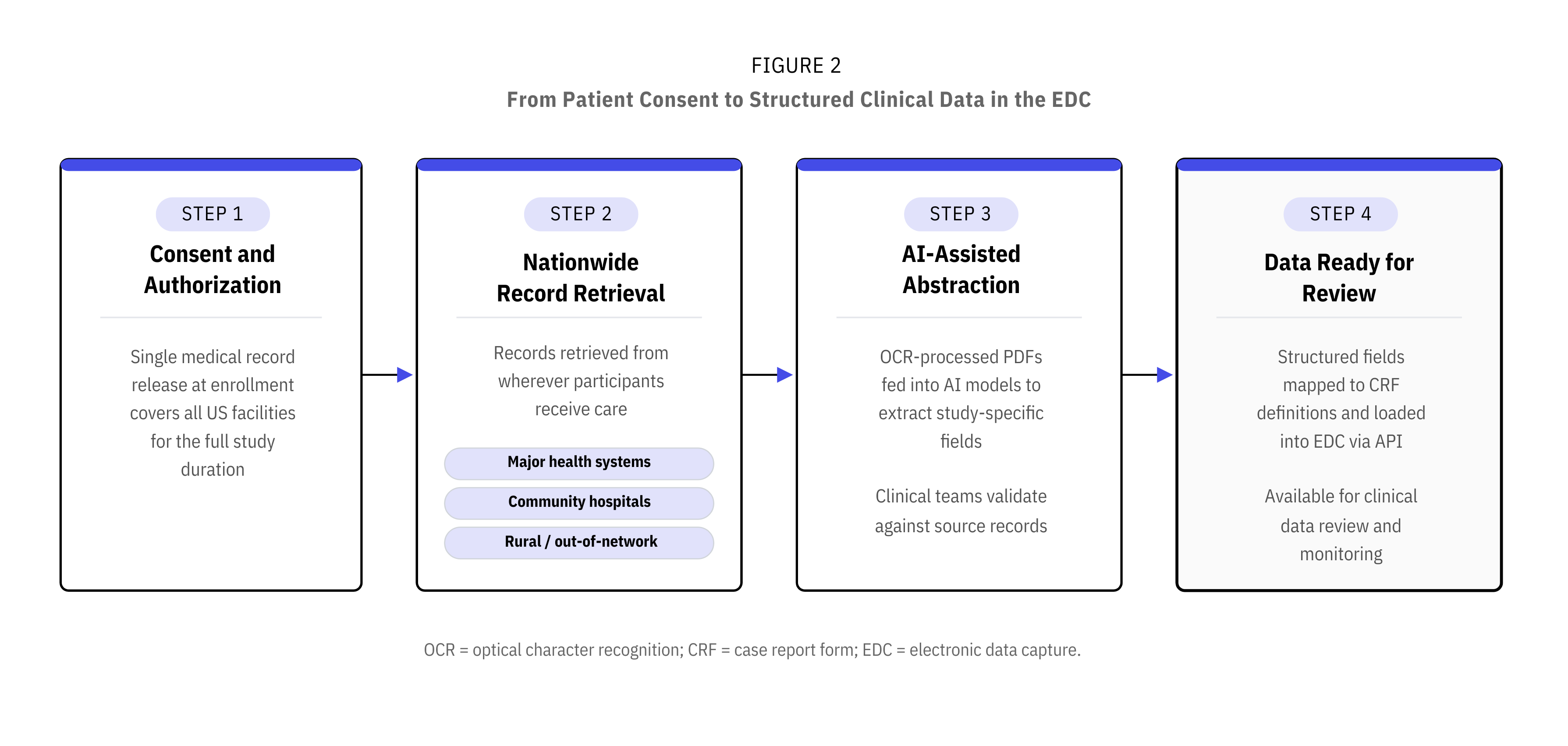
This begins at enrollment, where participants complete a single HIPAA authorization during the consent process that covers retrieval from any US facilities the patient may use for the duration of the study. There are no per-provider authorization forms required in the majority of cases; however, a small proportion of facilities may require a provider-specific authorization. One signature at enrollment covers the life of follow-up for the vast majority of record pulls, with a pre-built process for handling additional authorizations where needed.

A nationwide retrieval partner with an embedded footprint across major US health systems provides direct access to records, with field teams extending coverage to rural and out-of-network facilities. Multiple follow-up attempts per request are built into the process to maximize completeness.

The output is searchable, OCR-processed PDF medical records covering encounters, procedures, labs, imaging reports, pathology, diagnoses, and treatments. These records feed directly into the AI-assisted abstraction and clinical data review workflows described below, where study-specific fields are extracted, mapped to CRF definitions, and loaded into the EDC. Figure 2 outlines this end-to-end workflow.
Smart Triage to Control Costs Without Sacrificing Data Completeness

In a long-term follow-up study, medical record retrieval is a recurring operation. Records generally need to be checked at regular time points over years across the full study population. Pulling records for all participants at every interval would be prohibitively expensive when the vast majority remain cancer-free.

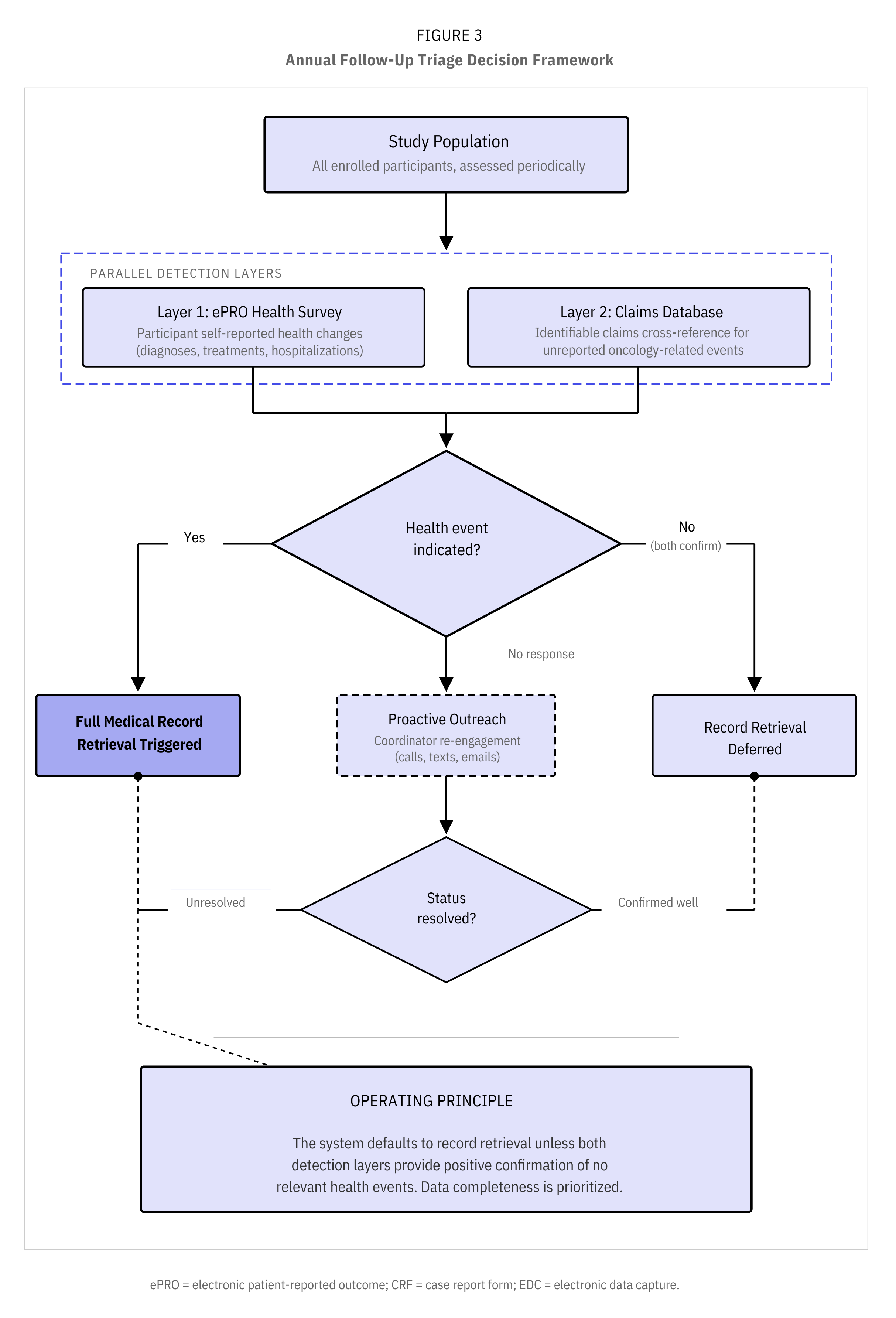
A layered triage approach solves this. The ePRO health status survey serves as the primary detection layer across the entire study population. Cross-referencing against an identifiable claims database provides a supplementary check that catches oncology-related health events participants may not self-report, such as incidental findings or care received outside their usual provider. Full medical record pulls can be triggered for participants where either the ePRO or the claims data indicates a relevant health event. Participants who report no changes and have no oncology claims can have their record pull skipped for that period. Figure 3 demonstrates this decision framework.
To put this in perspective: in a 25,000-participant study where an estimated 2-3% may develop cancer annually, the triage approach concentrates record pulls on the subset with confirmed or suspected health events rather than pulling for all 25,000 each year. The specific criteria that trigger a pull are aligned between the sponsor, the CRO, and the retrieval partner, ensuring the triage logic matches the study's endpoint definitions. Those savings compound with each year of follow-up, all while maintaining complete data capture for every clinically meaningful event.

Where Long-Term Follow-Up Breaks Down

Keeping Asymptomatic Participants Engaged for Years

With tens of thousands of participants, even a modest annual non-response rate to ePRO surveys means thousands of people requiring follow-up outreach each cycle. If that outreach depends on manual effort, the coordinator team has to grow every year as the cumulative number of non-responders grows. The automation layer carries the majority of the workload: configurable reminder schedules, multi-channel outreach (email, SMS), and escalation workflows that automatically flag non-responders for human follow-up. Virtual patient coordinators then focus their time on the subset of participants who need direct outreach to complete study activities, rather than managing reminders for the entire population.

Maintaining Data Quality Across Repeated Annual Record Pulls

Quality validation is manageable when medical records are only retrieved once, but when the same process runs annually for years across the entire cohort, errors compound and edge cases multiply. A 2025 multicenter study across 10 institutions found that AI extraction from unstructured medical records had a lower error rate than manual abstraction (7% vs 14%), and that a hybrid AI-human workflow further reduced errors to 4.4%. The same principle applies here: AI models extract structured data at each timepoint, clinical data teams compare abstracted output against source PDFs, and edge cases are fed back into the models to improve accuracy over time. Source PDFs are retained alongside abstracted data for audit trail and source data verification. For the most critical fields, human abstractors can manually key data as a high-control fallback. We've built API integrations between retrieval partners and the EDC on another large diagnostic trial, mapping abstraction fields directly to CRFs and eliminating manual data entry.

Participants Who Don't Respond to Either Detection Layer

The triage system works when participants complete their ePRO or appear in the claims database. Over five years at this volume, some will do neither, and the system needs to account for this. Non-responders receive proactive outreach from virtual patient coordinators (calls, texts, emails) to re-engage them and collect their health status. If a participant's status remains unknown after outreach, they are treated as requiring a record pull rather than skipped. The triage logic only skips a pull when there is positive confirmation of no relevant health events from the ePRO, the claims database, or both. This means the system defaults to over-pulling rather than risking a missed cancer case, which is the right trade-off for a study where every event matters for endpoint validity.

Building on What Works

The infrastructure described in Part 1 for enrollment, identity verification, sample collection, and data capture provides the foundation. Long-term follow-up adds a layer of sustained engagement and repeated data collection, requiring its own operational systems. The ePRO engagement layer, the triage logic for targeted record pulls, and the retention workflows are purpose-built for this phase of the study and are architected to scale to the volumes required by next-generation MCED studies.

In prior studies with extended follow-up periods, we've achieved retention rates as high as 90% over 12 months in a rare disease population (a Myasthenia Gravis symptom-tracker study), where retention was a known challenge, an approach recognized by Fierce Biotech in the Fierce CRO awards, where we won the Outstanding Patient Recruitment and Retention category. Our partnership with a nationwide medical record retrieval network provides broad access to US electronic medical records, with validated API integrations that map abstraction fields directly to CRFs. These capabilities are in active use across our current portfolio of large-scale diagnostic trials.

If you're running or planning a large-scale screening trial and need confidence that your long-term follow-up data will be complete when it matters most, Lindus can help you design the operational model and deploy the systems to make it happen.

This is Part 2 of a three-part series on operational strategies for large-scale liquid biopsy screening trials. In Part 3, we'll address how to ensure FDA-grade evidence quality when collecting data through virtual and hybrid pathways.


This is some text inside of a div block.

Lorem ipsum dolor sit amet, consectetur adipiscing elit. Suspendisse varius enim in eros elementum tristique. Duis cursus, mi quis viverra ornare, eros dolor interdum nulla, ut commodo diam libero vitae erat. Aenean faucibus nibh et justo cursus id rutrum lorem imperdiet. Nunc ut sem vitae risus tristique posuere.

Continue reading

More from Lindus

Lindus BG Image
20 May 2026
Blog

What James Lind would ask us on Clinical Trials Day

What James Lind would ask us on Clinical Trials Day is whether the systems we have built are worthy of the participants, sites, investigators, and teams who make clinical research possible.We do not think they are yet, but we know they can be.

Lindus BG Image
11 Mar 2026
Blog

Achieving FDA-Grade Data Quality in Large-Scale Liquid Biopsy Screening Trials

"The data pipeline, from medical record retrieval to structured EDC output, has to be designed for regulatory scrutiny from the start. Retrofitting data quality into an operational model that wasn't built for it creates avoidable risk at exactly the wrong stage of a program."

Lindus BG Image
17 Feb 2026
Blog

Scaling Liquid Biopsy Trial Enrollment Through Decentralized and Hybrid Models

"Clinical trials for diagnostics are increasingly time-consuming and expensive, given the large volumes of patients required. Identification and proper enrollment at accredited sites alongside novel methods of reaching patients remotely are promising developments for speeding and focusing efforts."

Lindus BG Image
20 Jan 2026
Blog

Why the FDA's Bayesian Draft Guidance Matters for Clinical Development

Last week, the FDA published draft guidance designed to facilitate the use of Bayesian methodologies in clinical trials of drugs and biologics. It is a welcome step toward faster, more practical clinical development that puts patients first, especially those for whom a clinical trial is often their best hope.